Blog
19 October 2026
A leak in a flat roof does not always give warning. Sometimes it is a brownish stain on the ceiling that draws attention; other times, it is water dripping after a heavy rain. However it shows up, a leak in a flat roof in Lavaltrie must be taken seriously from the first signs: the longer you wait, the more the damage spreads and the bigger the repair is likely to be.
Here is how to recognize a leak, where it most often comes from and what repair options exist depending on the condition of the membrane.
A flat roof keeps water on its surface longer than a sloped roof. Even with slight slopes toward the roof drains, it remains exposed to conditions that wear down the waterproofing membrane.
The Quebec climate has a lot to do with it: freeze-thaw cycles weaken materials, temperature swings make the membrane work, snow builds up, and then thaws and spring rains send a lot of water toward the roof drains. When the membrane has a weak spot, water gets in.
Detection is not always simple. Water can enter at one spot, travel under the membrane or through the insulation, then show up inside several metres from its point of entry. That is why it is difficult to locate the source of a leak yourself.
The search begins with a roof inspection : condition of the membrane, seams, upstands, penetrations and roof drains, taking into account where the water appears inside and the path it may have followed. The goal is to repair the real source of the problem, not just the spot where the stain is visible.
Several signs can point to a leak: damp spots or brownish rings on the ceiling, blistering paint, warping plaster or drywall, a musty smell or visible mould. If you notice any of these signs, have your roof inspected without delay.
When access is safe, a look at the roof can reveal blisters, lifted sections, open seams around penetrations or water that stays on the surface several days after rain.
Not all leaks call for the same solution. The solution depends on the general condition of the membrane, the extent of the damage and the condition of the insulation.
When the leak is isolated and the membrane is in good overall condition, a localized repair may be enough. The area is cleaned and prepared, then a compatible patch of elastomeric membrane is torch-applied or self-adhered. Around a roof drain or a penetration, it often means redoing the waterproofing of the entire detail.
If several areas have problems but the membrane is not deteriorated everywhere, the problem sections can be replaced while keeping those that are still in good condition. When the membrane is worn on the surface but still watertight, resurfacing can also extend its life.
When the membrane is too worn, when leaks come back from one season to the next or when the insulation is saturated with water, continuing to repair only postpones the problem. An elastomeric roof replacement then becomes the solution to consider.
A makeshift repair can make things worse: a product that is incompatible with the membrane, a poorly redone seam or a repair in the wrong place hides the problem without solving it. An elastomeric membrane flat roof requires compatible materials and a precise installation technique.
Acting early also makes a difference. A leak left untreated can soak the insulation, damage the structure and promote mould. Each recurring leak increases the extent of the damage and the complexity of the repair.
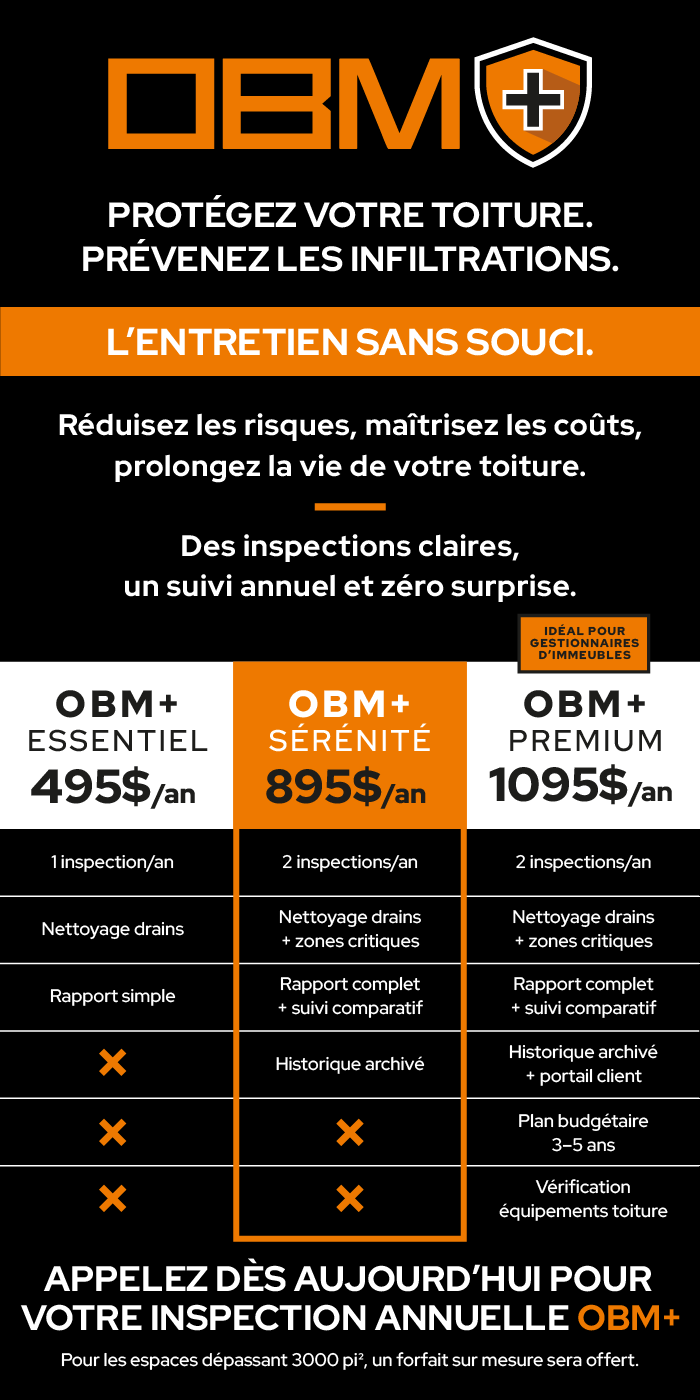
A leak that is prevented does not need to be repaired. An inspection in the spring, after the thaw, and another in the fall make it possible to check the membrane, upstands, roof drains and penetrations. Cleaning the roof drains before the first snowfall and having the roof checked after a major storm are simple steps that reduce the risk of leaks.
Toitures OBM specializes in elastomeric membrane flat roofs: flat roof repair, roof replacement, resurfacing, maintenance and inspection, as well as new construction. Located at 1215 Tellier Street in Laval, the company carries out work in Lavaltrie on commercial, industrial and multi-unit buildings, as well as on residential flat roofs.
Before recommending a repair, the Toitures OBM team assesses the condition of the roof to avoid unnecessary work and clearly explains its recommendations. The company is Soprema PAQ+S certified, CAA-Québec Recommended and holds RBQ licence 5778-2823-01.
On a flat roof, water that gets through the membrane can travel underneath it and through the insulation before finding a way inside. The stain therefore sometimes appears several metres from the point of entry, which is why it is important to inspect the roof rather than only repairing above the stain.
A sealant can temporarily limit water entry, but it does not replace a membrane repair. An incompatible product can even interfere with a future repair. A lasting repair is done with a compatible elastomeric membrane.
No, not necessarily. When the membrane is in good overall condition, a localized repair is often enough. A roof replacement should be considered only when the membrane is at the end of its life or the insulation is wet over a large area.
If you suspect a leak in the flat roof of your building in Lavaltrie, don’t wait for the situation to get worse. Contact the Toitures OBM team at 514-449-5469, Monday to Friday from 8 a.m. to 5 p.m., or fill out the form to get a free quote.
OBM Roofing
Elastomeric membrane specialists for commercial, industrial and multi-unit buildings in Laval, Montreal and the North Shore.