Blog
14 September 2026
A leaking flat roof is rarely something you can afford to ignore. In Montreal, flat-roof plexes, apartment buildings and commercial buildings go through freeze-thaw cycles, snow and heavy rain every year. What starts as a small leak can quickly damage the insulation, ceilings and structure if no one deals with it.
Understanding the causes of a leak, knowing how to recognize the signs and knowing the repair options are the first steps to protecting your building.
A flat roof isn’t completely horizontal: it is designed with slight slopes that direct water toward the roof drains. When this drainage doesn’t work well, water stands and seeks out the slightest weak spot. That’s why leaks often appear in the same places.
Among the most common causes:
Freeze-thaw cycles make these problems worse: water that seeps into a crack freezes, expands and widens the opening.
Flat roof leaks are not always obvious. Water can travel under the membrane or through the insulation before showing up inside. The stain on the ceiling is therefore not always directly below the damaged area.
Brownish stains on the ceiling, paint that blisters or peels, a persistent musty smell or a sagging ceiling are signs that water infiltration is probably under way. In an apartment building, it is worth asking top-floor occupants to report any sign of water quickly.
On the roof, look at the areas around the roof drains, penetrations and upstands. Blisters under the membrane, delamination, cracks, puddles that remain several days after rain or granules piling up in the corners are warning signs. If you are not comfortable going up on the roof, a roofer can carry out this inspection safely.
There is no one-size-fits-all solution. Everything depends on the extent of the damage, the overall condition of the membrane and the cause of the water infiltration.
When the damage is limited to a specific area, a localized repair is often enough. The area is cleaned and dried, the damaged sections are removed, and then a new SBS modified bitumen membrane is applied, overlapping the sound membrane. This solution works well for isolated problems on a membrane that is still in good condition.
The leak often does not come from the middle of the membrane, but from around a roof drain, a vent or a duct. Resealing these spots solves a good share of water infiltration problems without requiring major work.
If the membrane surface is worn but not punctured, resurfacing (cleaning, preparation of the existing membrane and a new cap sheet) can extend its service life. If the membrane is too deteriorated or the insulation is waterlogged, a elastomeric roof replacement becomes the more logical choice. Patching a roof at the end of its life over and over again often costs more in the long run.
Some owners try to seal a leak with store-bought products. This approach can help in a pinch for a very minor problem, but it often hides the cause without fixing it, and one more winter on a fragile membrane can make things worse.
A roofer specialized in elastomeric membrane flat roofs finds the real source of the water infiltration, uses materials compatible with the existing membrane and spots other areas to keep an eye on along the way. A repair done right reduces the risk of the leak coming back the following season.
Water that gets into a roof soaks the insulation, encourages mould growth and weakens materials. What could have been fixed with a minor repair can quickly lead to major interior repair work. A leak caught early is usually simpler to repair, especially if it is dealt with before another winter goes by.
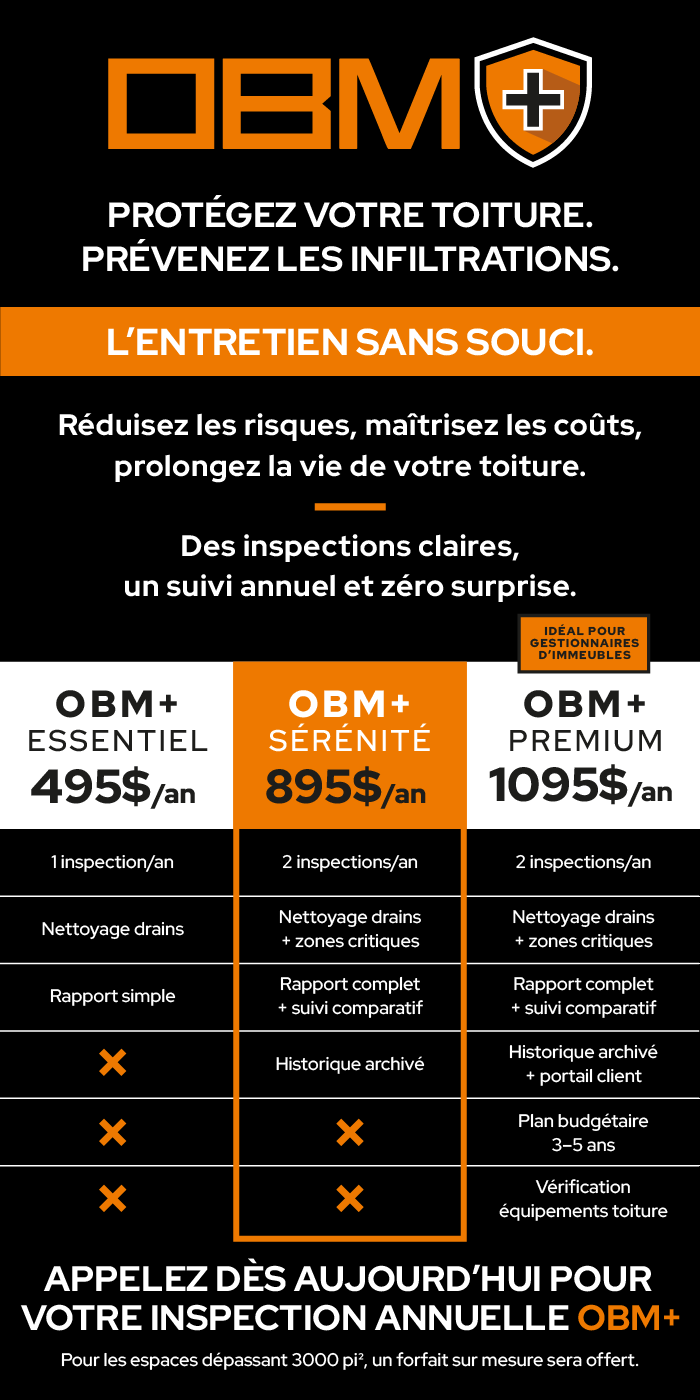
Toitures OBM is a roofer specialized in elastomeric membrane flat roofs, located at 1215 Tellier Street in Laval. Montreal is one of its main markets: the team works in several areas there, such as Ahuntsic-Cartierville, Anjou and Montréal-Nord. It offers flat roof repair, resurfacing, maintenance and inspection, elastomeric roof replacement and new flat roof construction, for commercial buildings, industrial and multi-unit buildings as well as residential flat roofs.
Toitures OBM installs Soprema systems, is Soprema PAQ+S certified and CAA-Québec Recommended, and holds RBQ licence 5778-2823-01. Before recommending anything, the team assesses the condition of the roof to avoid unnecessary work, then clearly explains its recommendations. Financing is also available through Financeit.
Place a container under the drip, protect furniture and flooring, and note where the water appears as well as the weather conditions (rain, snowmelt). This information helps the roofer trace the leak back to its source.
Not necessarily. A frozen or clogged roof drain can cause meltwater to rise above the upstands or the seams. An inspection makes it possible to tell a drainage problem apart from a membrane failure.
Often, yes, when the rest of the membrane is in good condition. If the inspection reveals a membrane worn over a large area or wet insulation, the team explains it and presents the possible options.
If you have doubts about the condition of your flat roof, an inspection gives a clear picture of the situation. Contact Toitures OBM at 514-449-5469, Monday to Friday from 8 a.m. to 5 p.m., or request a free quote.
OBM Roofing
Elastomeric membrane specialists for commercial, industrial and multi-unit buildings in Laval, Montreal and the North Shore.