Blog
12 October 2026
In Quebec, roofs have to contend with snow, freeze-thaw cycles, spring rain and summer heat. In Morin-Heights as elsewhere, choosing a roofing system suited to these conditions is not a decision to be taken lightly. Often misunderstood, the flat roof is nonetheless a durable and effective solution for many owners and building managers, provided it is well designed, properly installed and well maintained.
People sometimes have reservations about flat roofs in a northern climate. Yet today’s membranes and installation techniques allow a well-designed flat roof to offer a long service life, even with demanding winters.
One of the main advantages of a flat roof is its accessibility. It makes inspection, maintenance and, when needed, repairs easier. There is no need to work on a sloped surface: everything is within easy reach. For commercial and industrial buildings or apartment buildings, this is an asset that helps keep maintenance costs under better control.
The key to a durable flat roof lies in the choice of waterproofing system. Elastomeric membrane, made of SBS (styrene-butadiene-styrene) modified bitumen, stands up well to freeze-thaw cycles, UV rays and mechanical wear. It stays flexible even at low temperatures, which reduces the risk of cracking during extreme cold.
It is installed as a two-ply system: a base sheet, then a granulated cap sheet. Together, these two layers form a continuous watertight barrier. Toitures OBM uses Soprema systems, torch-applied or self-adhered depending on the building.
When a flat roof reaches the end of its life or shows significant signs of deterioration (water infiltration, blisters, delamination, ponding water), it is time to consider a elastomeric roof replacement.
It all starts with a thorough inspection. The roofer assesses the condition of the existing membrane, the insulation, the upstands, the penetrations and the roof drains. This diagnosis determines whether a repair or resurfacing may be enough, or whether a complete roof replacement is needed. The goal is to avoid unnecessary work.
If a roof replacement is needed, the old membrane is removed. The surface is cleaned and prepared to receive the new system. Damaged insulation is replaced. It is often at this stage that hidden problems are discovered, such as moisture trapped in the insulation, which could have undermined the durability of the new roofing.
The membrane is then installed according to best practices. Particular care is taken with the finishing details (upstands, roof drains, edges, penetrations), since these areas are often the source of water infiltration.
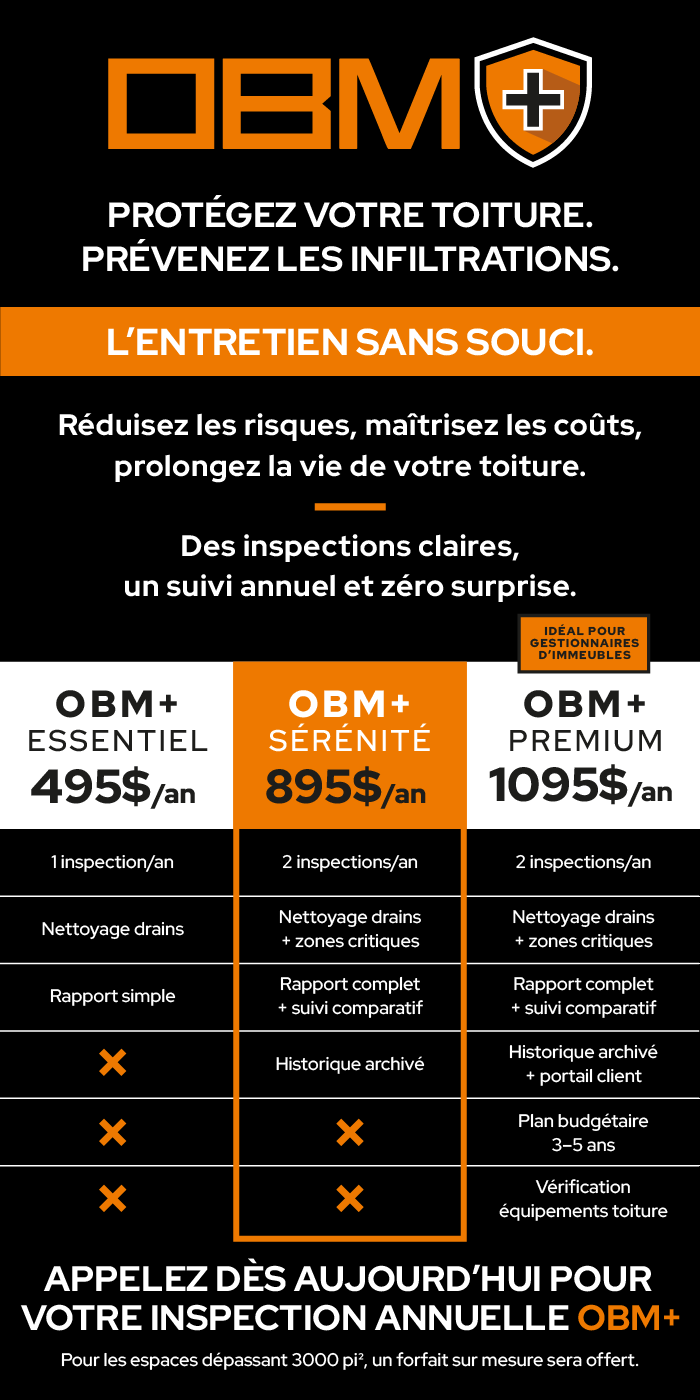
A flat roof should not be dealt with only when a problem arises. Preventive maintenance helps extend its service life and avoid major repairs. It is recommended to have the roof inspected twice a year: in the spring, to assess the effects of winter, and in the fall, to make sure everything is in order before the first snowfall.
During these inspections, the roofer checks the overall condition of the membrane, the roof drains and water drainage, the seams, the upstands and the penetrations, and cleans the roof drains as needed. Minor work done promptly often prevents much more serious damage. With regular maintenance, an elastomeric membrane can protect a building for several decades.
Certain signs should alert the owner: moisture stains on the ceiling, a musty smell, visible delamination of the membrane or unusual water buildup after rain. Each of these symptoms deserves prompt attention. The earlier water infiltration is dealt with, the less damage it causes to the building’s structure.
A durable flat roof does not always require a complete roof replacement. When the damage is localized, a repair (resealing around roof drains and penetrations, cracks or delaminated sections) is often enough. When the membrane is sound but its surface is worn, resurfacing (cleaning, preparation of the existing membrane and a new cap sheet) extends its service life. Roof replacement is reserved for roofs whose membrane or insulation can no longer be salvaged.
Toitures OBM is a roofer specialized in elastomeric membrane flat roofs, located at 1215 Tellier Street in Laval. Its service area covers Laval, Montreal and the North Shore, from Sainte-Adèle to Montreal and from Lachute to Repentigny. The team works in Morin-Heights and the surrounding area, such as Saint-Sauveur and Sainte-Adèle. Its services include elastomeric roof replacement, new flat roof construction, repair, resurfacing, and maintenance and inspection, for commercial, industrial and multi-unit buildings and for residential flat roofs.
Toitures OBM is Soprema PAQ+S certified and CAA-Québec Recommended, and holds RBQ licence 5778-2823-01. Its recommendations are clear and explained. Financing is available through Financeit.
The roof’s capacity depends on the building’s structure, not just the membrane. The elastomeric membrane itself stands up well to cold and to freeze-thaw cycles. For any question about snow load, have the structure assessed by a qualified professional.
Water that sits in the same spot for several days speeds up membrane wear and eventually finds the slightest weak point. Clean roof drains and well-designed slopes help drain it away.
The overall condition of the membrane, the roof drains and water drainage, the seams, the upstands and the penetrations. The roof drains are also cleaned as needed.
Well designed, properly installed and regularly maintained, an elastomeric membrane flat roof protects your building for many years. To have your roof assessed in Morin-Heights, contact Toitures OBM at 514-449-5469, Monday to Friday from 8 a.m. to 5 p.m., or request a free quote.
OBM Roofing
Elastomeric membrane specialists for commercial, industrial and multi-unit buildings in Laval, Montreal and the North Shore.