Blog
22 June 2026
Damp spots on the ceiling, a musty smell that settles in, blistering paint: these signs often point to water infiltration through the roof. Whether you own a plex, an apartment building or a flat-roofed commercial building in Ahuntsic-Cartierville, in Montreal, a leak should never be taken lightly. Here is how it forms, how to recognize it and what solutions are available to you.
A flat roof is never completely flat: it has a slight slope that directs water toward the roof drains. Because this slope is gentle, water drains slowly. When the roof drains are clogged or the membrane has a defect, water can pool and seek out the smallest weak spot.
The Quebec climate adds constant pressure. Water that gets into a small crack freezes, expands, then thaws. Repeated all winter long, this freeze-thaw cycle widens openings and wears out seams. Melting snow in the spring and heavy summer rains then put the waterproofing to the test. Even a quality membrane will eventually deteriorate if it is not maintained.
The membrane is the first line of defence against water. On an elastomeric membrane roof, the SBS modified bitumen two-ply system stands up well to temperature swings, but it ages too. Over the years, cracks, blisters or lifted sections can appear, all of which are entry points for water.
Membrane upstands and flashings protect the junctions between the roof and walls, parapets, chimneys or vents. If these details are poorly sealed or come loose over time, water easily slips in. This is one of the most common causes of water infiltration on flat roofs.
Leaves, sand, wind-blown debris: roof drains clog faster than you might think. A blocked roof drain lets water build up on the roof, which increases the load on the membrane and the risk of infiltration, especially around the drain itself.
Every duct, vent or equipment support that passes through the roof creates an opening that must be made watertight. With the movement of materials and frost, the waterproofing around these penetrations can give way and let water through.
Less visible, the vapour barrier limits the migration of indoor moisture into the roof layers. If it is poorly installed or damaged, condensation can form in the insulation and cause damage with no visible sign for a long time.
Keep in mind that water can travel a good distance under the membrane before showing up inside. The stain on the ceiling is therefore not always located under the actual source of the leak.
It is tempting to put off a repair that seems minor. Yet this is often how damage grows. An untreated leak soaks the insulation under the membrane, which then loses much of its effectiveness. The building becomes harder to heat, and the trapped moisture promotes mould.
Over time, water can also reach the roof deck and the roof structure. In an apartment building, a leak quickly affects several occupants and can damage ceilings, walls and interior finishes. Acting early reduces the risk of having to redo a large part of the roof.
The first step is a complete inspection of the flat roof. A specialized roofer examines the membrane, roof drains, upstands, flashings and penetrations to identify the source or sources of the leak. This assessment makes it possible to understand the problem before recommending anything.
If the membrane is still in good condition and the damage is localized, a targeted repair may be enough: redoing the waterproofing around a roof drain or a penetration, fixing a crack or a lifted section. If the membrane is at the end of its life or the insulation is saturated with water, an elastomeric roof replacement will make more sense than a series of patch jobs.
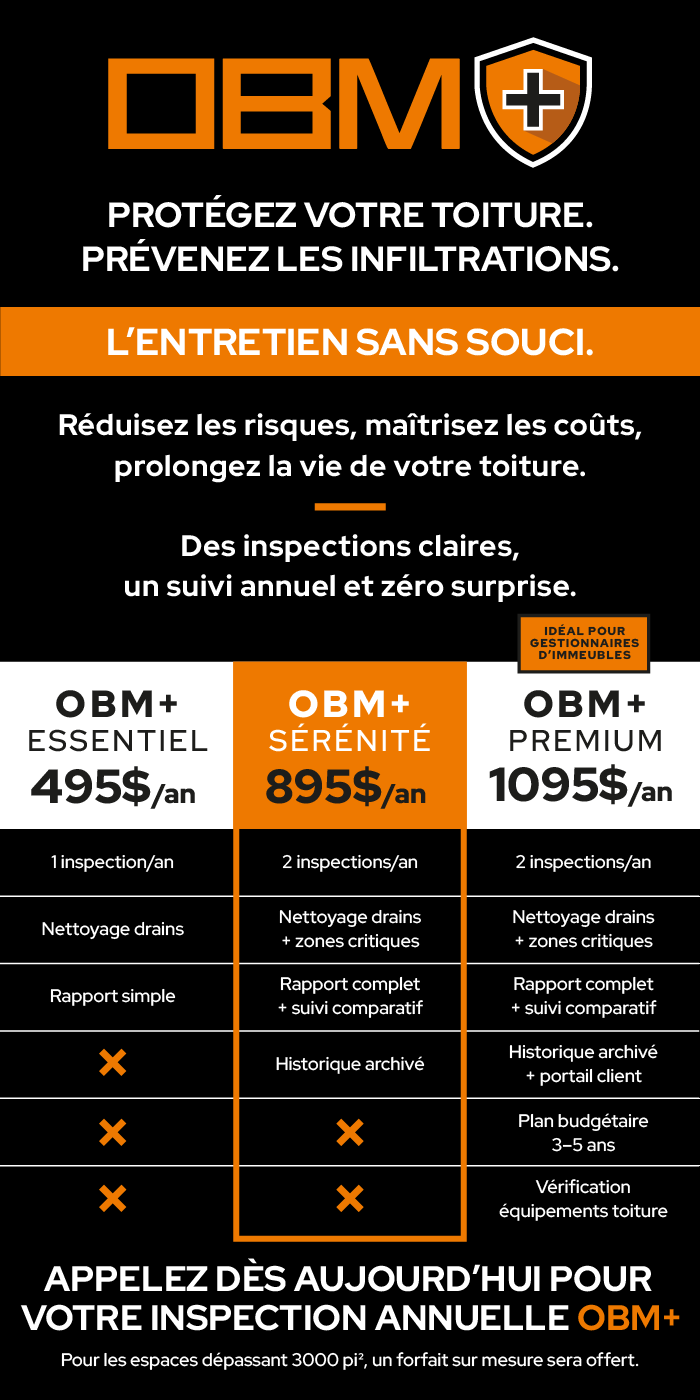
Once the work is completed, regular maintenance helps prevent new leaks: cleaning the roof drains, checking the seams and upstands, inspecting the general condition of the membrane. These simple steps extend the lifespan of the roof.
Toitures OBM is a roofing contractor specializing in elastomeric membrane flat roofs, located at 1215 Tellier Street in Laval. The team works in Ahuntsic-Cartierville and elsewhere in Montreal, as well as in Laval and on the North Shore, on commercial, industrial and multi-unit buildings, as well as on residential flat roofs.
Its services include flat roof repair, elastomeric roof replacement, resurfacing, maintenance and inspection, as well as new flat roof construction. The company installs Soprema systems; it is Soprema PAQ+S certified, CAA-Québec Recommended and holds RBQ licence 5778-2823-01. Every recommendation is based on a thorough assessment of the roof’s condition, to avoid unnecessary work. Financing is offered through Financeit.
Not always. A stain can come from water infiltration through the roof, but also from condensation caused by a faulty vapour barrier or from a plumbing problem. A roof inspection makes it possible to confirm the cause before undertaking any work.
Some targeted repairs can be done in the cold season, depending on conditions on the roof. A complete roof replacement is better planned when the weather allows. The inspection helps determine what needs to be done now and what can wait.
An inspection in the spring and another in the fall is a good habit, especially for an apartment building or a commercial building. A check after a major storm or a heavy snow buildup is also useful.
Are you noticing signs of water infiltration on your flat roof in Ahuntsic-Cartierville? Contact the Toitures OBM team at 514-449-5469, Monday to Friday from 8 a.m. to 5 p.m., or request a free quote.
OBM Roofing
Elastomeric membrane specialists for commercial, industrial and multi-unit buildings in Laval, Montreal and the North Shore.