Blog
5 October 2026
Owning an apartment building in Montreal, whether it is a duplex, a triplex, a plex with several units or a larger building, means taking on a responsibility toward your tenants. The flat roof is one of the most critical parts of the building: when it lets water through, units and the occupants’ belongings are affected.
Understanding how a flat roof works, how to monitor it and when to replace it helps you make good decisions before water damage forces your hand.
In Montreal, flat roofs are very common on plexes and apartment buildings. They suit large, rectangular buildings, they allow mechanical equipment such as ventilation or air conditioning units to be installed, and they remain accessible for maintenance.
On the other hand, they require particular attention to waterproofing and drainage. Water does not run off by gravity as it does on a sloped roof: it must be directed toward the roof drains by slight slopes. If a roof drain gets clogged or the membrane has a weak spot, water builds up and eventually seeps in.
A successful elastomeric membrane is a two-ply SBS modified bitumen system: a base sheet and a cap sheet, usually covered with granules that protect it from UV rays. Both plies are torch-applied or self-adhered, depending on the system chosen and the building’s constraints.
Its flexibility allows it to follow the building’s movements caused by temperature swings, which is useful in the Quebec climate with its freeze-thaw cycles. Soprema systems, for example the conventional mechanically fastened system or the conventional self-adhered system, are chosen based on the existing substrate, the insulation and the roof configuration.
On an apartment building, the roof often has many penetrations: plumbing vents from each unit, ventilation ducts, equipment bases, skylights. Each one is a junction between the membrane and another component. The upstands along parapets and party walls are also sensitive areas. The quality of these details weighs heavily on the watertightness of the whole roof.
A leak in an apartment building does not have the same consequences as in a house. Water can pass through a top-floor unit before being noticed, damage a tenant’s belongings, soak the insulation and promote mould. The owner must then manage interior repairs, communication with tenants and, sometimes, their insurer.
The work itself also requires planning: roof access, occupants on site, noise, material storage and protection of entrances. To find out whether a permit is required, check with your borough.
When a problem arises, the same question often comes up: should the roof be repaired or replaced?
A repair is appropriate when the damage is localized and the membrane is in good overall condition. A localized leak, an open seal around a penetration, a crack or a lifted section can be corrected without redoing the entire surface. When the membrane is worn on the surface but still sound, resurfacing can also extend its life.
A roof replacement becomes the solution to consider when the membrane reaches the end of its life, when repairs pile up from one year to the next or when the insulation is wet. On an apartment building, delaying this decision exposes you to water damage in the units and to heavier work. An assessment of the roof’s actual condition makes it possible to choose without doing unnecessary work.
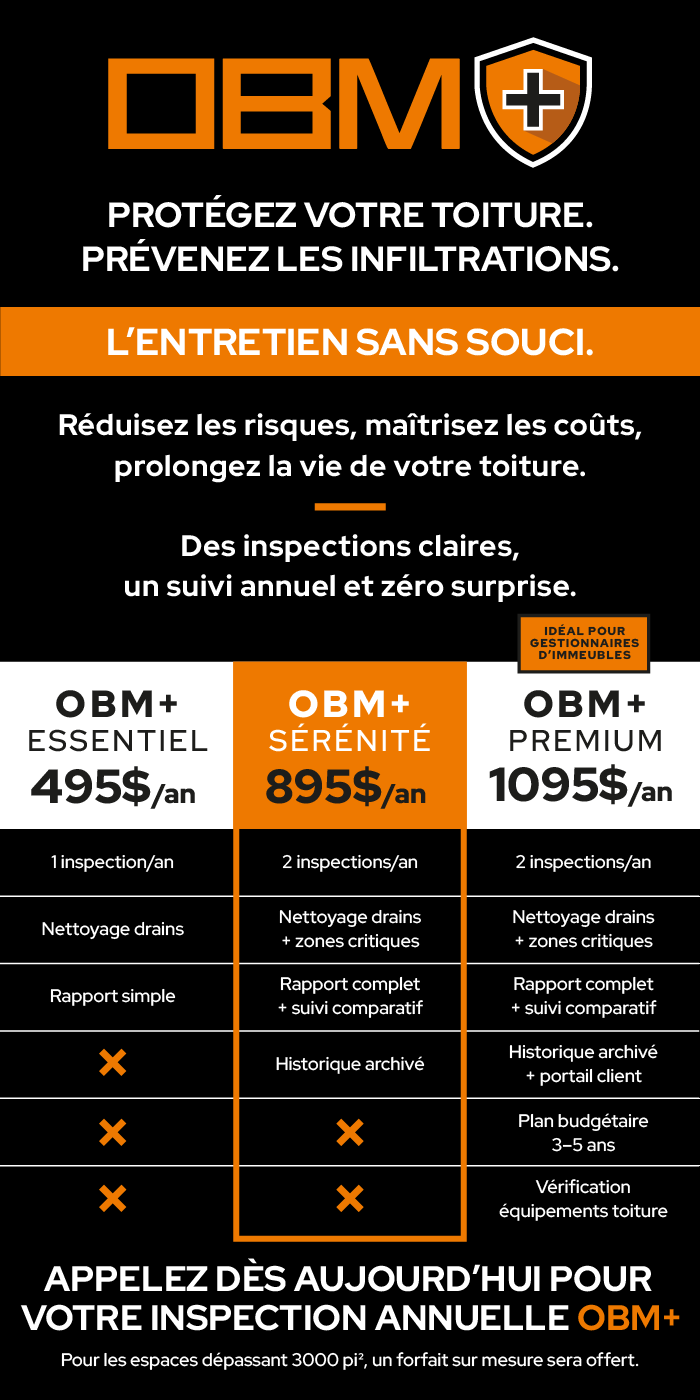
Preventive maintenance is the simplest way to extend the life of a flat roof. For an apartment building, two inspections a year are a good benchmark: in the spring, after the snow melts, and in the fall, before winter. A check after a major storm is also useful.
Keep a record of inspections and repairs. It makes managing the building easier and will be useful when reselling or dealing with your insurer.
Toitures OBM specializes in elastomeric membrane flat roofs for commercial, industrial and multi-unit buildings, including plexes and apartment buildings. Located at 1215 Tellier Street in Laval, the company carries out work in Montreal, Laval and on the North Shore: elastomeric roof replacement, new flat roof construction, repair, resurfacing, as well as maintenance and inspection.
The team first assesses the condition of the roof and the needs of the building, then presents clear, well-explained recommendations. Toitures OBM is Soprema PAQ+S certified, CAA-Québec Recommended and holds RBQ licence 5778-2823-01. Financing is offered through Financeit.
Yes, it is best to inform them in advance of the work period, the possible noise and the access points that will be used. Good communication helps the project run smoothly and reduces inconvenience.
Depending on the roof configuration and the condition of the membrane, it is sometimes possible to plan the work in sections. This decision depends on the roof assessment: a membrane at the end of its life over the entire surface generally requires a complete roof replacement.
Take the report seriously and have the roof inspected without delay. A stain can appear far from the point where water enters, because water travels under the membrane and through the insulation before showing up. Also check that the roof drains are not clogged.
A flat roof that is monitored and maintained protects the building, the units and the building’s rental income. To have the flat roof of your apartment building in Montreal assessed, contact Toitures OBM at 514-449-5469, Monday to Friday from 8 a.m. to 5 p.m., or request a free quote using the form.
OBM Roofing
Elastomeric membrane specialists for commercial, industrial and multi-unit buildings in Laval, Montreal and the North Shore.