Blog
21 September 2026
Is your flat roof showing signs of wear: repeated leaks, blisters on the membrane, puddles that sit after every rain? It may be time to consider a roof replacement. In Montreal, plexes, apartment buildings and commercial buildings with flat roofs go through freeze-thaw cycles, snow and UV rays every year. Neglecting a roof at the end of its life can quickly lead to damage to the insulation, ceilings and structure.
Here is an overview of a flat roof replacement, the signs that call for one and how the work is carried out.
A roof replacement is more than a patch job. It involves replacing theroof waterproofing system : the membrane and, if needed, the insulation, along with correcting any parts of the substrate that require it. Unlike a one-off repair, a roof replacement lets you start over on a sound base.
This type of work is generally recommended when the membrane reaches the end of its service life or when repeated repairs are no longer enough to contain leaks. At some point, continuing to patch holes costs more than redoing the roof properly.
A membrane that is coming loose, cracking over large areas or shrinking along the upstands, numerous blisters, granules missing over a good part of the surface or lingering puddles are serious warning signs. Recurring leaks despite successive repairs point the same way.
Moisture stains on the ceiling, a mouldy smell or an unexplained rise in heating costs can indicate wet insulation under the membrane. These problems sometimes seem minor at first, but they often reveal a failure of the waterproofing system.
An inspection confirms the extent of the damage and determines whether a roof replacement is truly necessary or whether a repair or resurfacing would be enough.
It all starts with a complete assessment: condition of the membrane, insulation, upstands, penetrations, roof drains and water drainage. This thorough analysis guides the work and reduces unpleasant surprises during the project.
The old membrane is removed and damaged insulation is replaced as needed. The substrate is inspected and corrected where necessary. A clean, dry surface is essential for the new membrane to bond properly.
The new roof is made of SBS modified bitumen membranes installed as a two-ply system. The first layer, the base sheet, provides the basic waterproofing. The second, the granulated cap sheet, protects the whole assembly from UV rays and the weather. Depending on the building, the membranes are torch-applied or self-adhered, for example with a Soprema mechanically fastened conventional or self-adhered conventional system.
Upstands, the areas around roof drains, vents, ducts and other penetrations require particular attention. These are often the spots where leaks begin. Careful work in these areas makes a big difference in the roof’s durability.
A flat roof replacement requires a good knowledge of multi-layer systems, connection details and water drainage. A roofer dedicated to elastomeric membrane flat roofs knows how to adapt the system to the building, whether it is a triplex, an apartment building, or a commercial or industrial building.
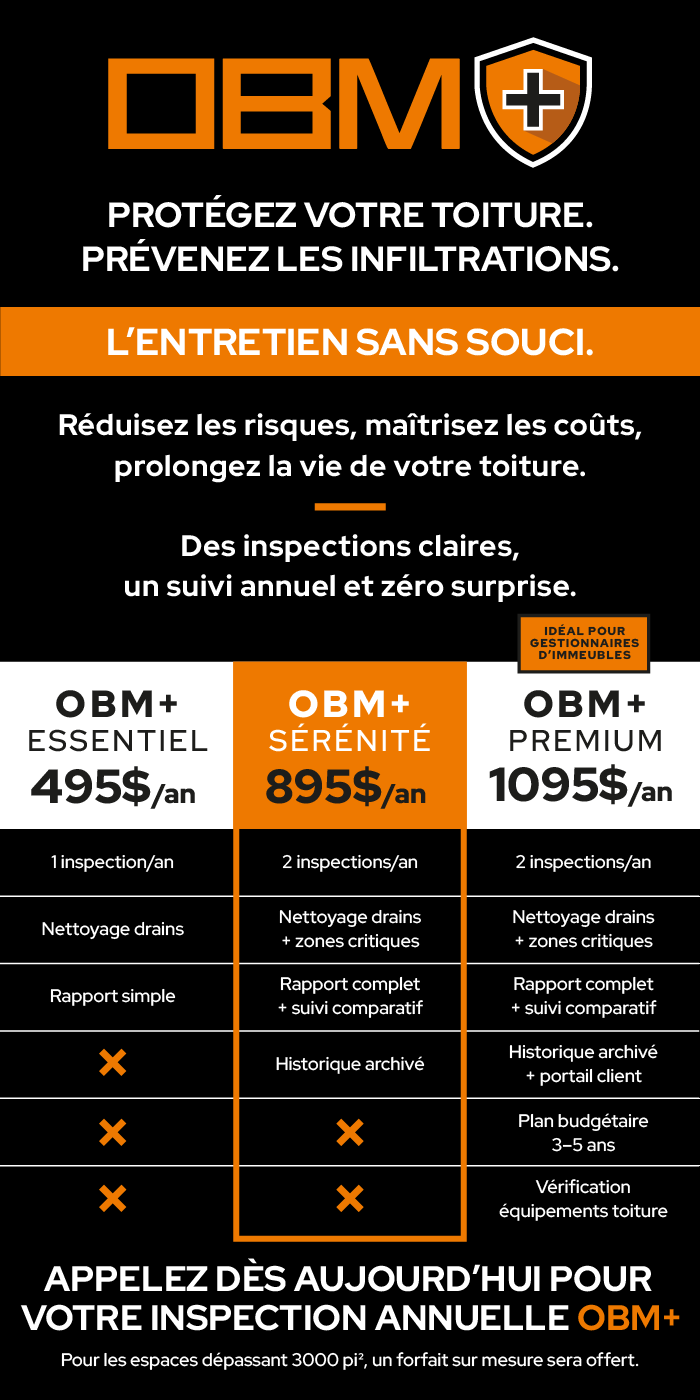
Follow-up matters too. A redone roof benefits from regular inspections, especially in spring and fall, to clean the roof drains and catch small issues early. With regular maintenance, an elastomeric membrane can protect a building for several decades.
The cost of a roof replacement depends on several factors: the roof area, the condition of the insulation, the number of penetrations, roof access and the chosen system. Only a site visit can provide a reliable estimate. To spread out the cost, Toitures OBM offers financing through Financeit.
A well-executed roof replacement protects the building, helps improve its energy efficiency and helps preserve its value.
Toitures OBM is a roofing contractor specializing in elastomeric membrane flat roofs, located at 1215 Tellier Street in Laval. Montreal is one of its main markets, with projects in areas such as Ahuntsic-Cartierville, Anjou and Montréal-Nord. The team offers elastomeric roof replacement, new flat roof construction, repair, resurfacing, and maintenance and inspection for commercial buildings, industrial and multi-unit buildings, as well as for residential flat roofs.
Toitures OBM installs Soprema systems, is Soprema PAQ+S certified and CAA-Québec Recommended, and holds RBQ licence 5778-2823-01. Before recommending a roof replacement, the team assesses the condition of the roof and the needs of the building to avoid unnecessary work, and clearly explains its recommendations.
No. Insulation that is dry and in good condition can sometimes be kept. Insulation that is wet or crushed must be replaced, because it reduces thermal efficiency and can damage the new membrane. The inspection makes it possible to tell the difference.
Generally, yes, since the work is done on the roof. Good planning prevents the roof from being left open to the weather. It is a good idea to let tenants know about the noise and the expected comings and goings.
Requirements vary depending on the borough and the type of work. Check with your municipality before the project begins.
If your flat roof shows signs of deterioration, an inspection will help you choose the right solution. Contact Toitures OBM at 514-449-5469, Monday to Friday from 8 a.m. to 5 p.m., or request a free quote.
OBM Roofing
Elastomeric membrane specialists for commercial, industrial and multi-unit buildings in Laval, Montreal and the North Shore.