Blog
29 June 2026
Damp stains on the ceiling, blisters on the membrane, a musty smell under the roof: these signs often mean that a flat roof’s waterproofing is failing. In Sainte-Adèle, as elsewhere in Quebec, snow, rain and freeze-thaw cycles put flat roofs to the test.
Flat roof waterproofing is the set of measures that keep it from letting water through. On the roofs that Toitures OBM maintains and installs, it relies on an elastomeric membrane made of SBS modified bitumen. This article explains where water gets in, how to spot the problem and how the waterproofing is restored.
On a flat roof, water flows slowly toward the roof drains thanks to a slight slope. Waterproofing therefore can’t rely on gravity alone: it depends on a continuous membrane, with no openings, that covers the entire surface and runs up the parapets.
The elastomeric membrane is installed in two plies. The base sheet forms a first barrier, and the granulated cap sheet protects it from the sun and wear. The seams of the two plies are staggered, which reduces the risk of a defect going through the entire system. Thanks to SBS, the membrane stays flexible in the cold and follows the building’s movements.
On a flat roof, water rarely gets through the middle of a membrane in good condition. Instead, it takes advantage of the spots where the membrane is interrupted, joined or worn.
The roof drain is the lowest point of the roof, where all the water converges. If the connection between the membrane and the drain comes loose, water gets in directly. A clogged drain makes the problem worse by keeping water on the roof.
The membrane rises vertically along walls and parapets. If an upstand comes loose or its top protection is damaged, water can get behind the membrane and run down into the wall or under the roof.
Plumbing vents, ventilation ducts, mechanical equipment bases: every element that passes through the roof creates an opening that must be sealed. Over time, these connections can crack or come loose.
A poorly welded seam, a blister that eventually bursts or an area where the granules have disappeared are also possible entry points, especially where water stands after a rain.
Some signs can be seen on the roof, others inside:
Water that gets in through the roof can travel along the insulation before showing up on the ceiling. So the stain isn’t always under the leak. An inspection on the roof makes it possible to trace the problem back to its source instead of only treating the symptom.
Toitures OBM assesses the condition of the roof and the needs of the building before recommending anything, to avoid unnecessary work. Depending on what the inspection reveals, waterproofing is restored in one of three ways.
When the problem is localized, flat roof repair targets the faulty spot: resealing around a drain or a penetration, fixing a crack or a section that has come loose.
When the membrane is ageing but still sound, resurfacing extends its protection: cleaning, preparing the existing membrane and applying a cap sheet.
When the membrane has reached the end of its life or the insulation is wet, a elastomeric roof replacement replaces the covering with a new two-ply system, with new connections at the roof drains, upstands and penetrations. Toitures OBM works with Soprema systems, such as the mechanically fastened conventional system or the self-adhered conventional system.
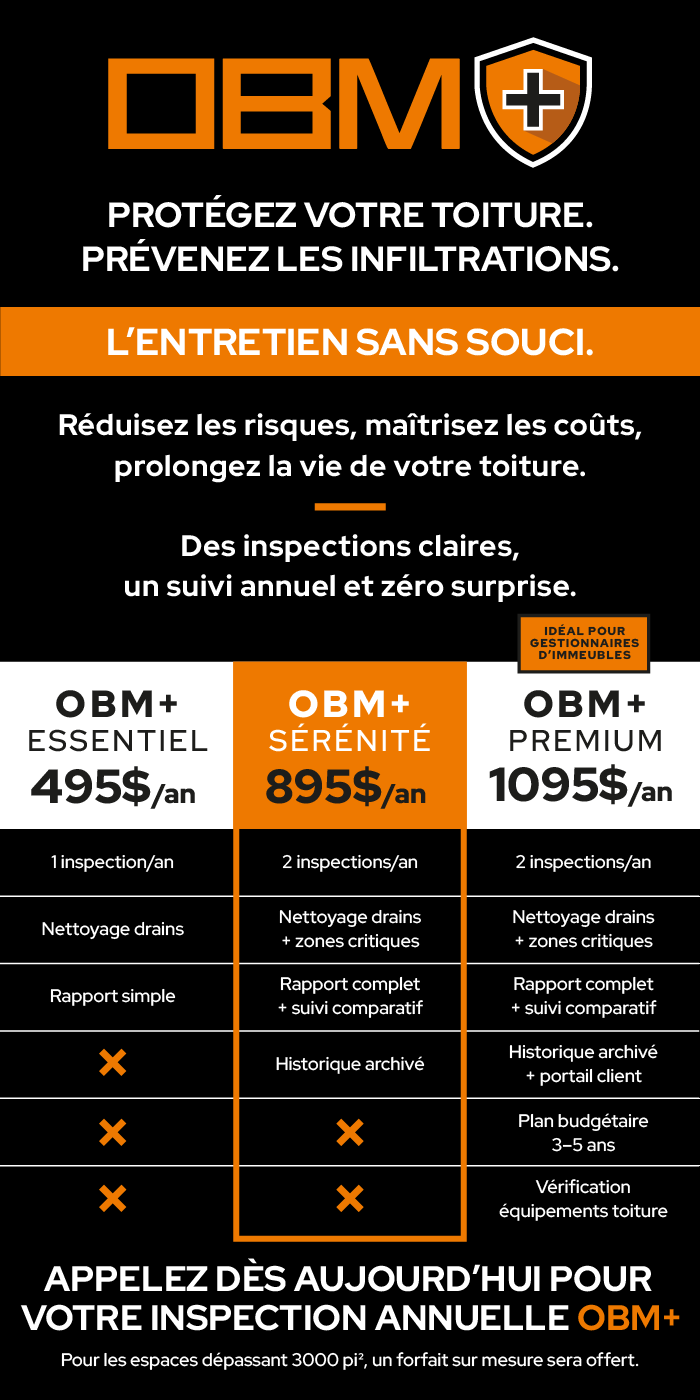
Waterproofing is preserved mainly through maintenance. An inspection in spring, after the thaw, and in fall, before winter, makes it possible to check the roof drains and water drainage, the seams, upstands, penetrations and the overall condition of the membrane, and to clean the roof drains. With this follow-up, a properly installed elastomeric membrane can protect a building for several decades.
Toitures OBM is a roofer specializing in elastomeric membrane flat roofing, based at 1215 rue Tellier in Laval. Its service area stretches from Sainte-Adèle to Montreal and covers commercial, industrial and multi-unit buildings as well as flat-roof homes.
Toitures OBM is Soprema PAQ+S certified, CAA-Québec Recommended and holds RBQ licence 5778-2823-01. Financing is available through Financeit.
Water that gets past the membrane can travel along the insulation or the roof deck before coming through the ceiling. That’s why the search for the source is done on the roof.
Not always right away. A blister does, however, indicate a bonding defect that can eventually crack the membrane. It’s worth examining during an inspection.
Yes. Penetrations are among the points checked at every inspection, in spring and in fall, because they are sensitive areas.
For an inspection or a waterproofing repair on your flat roof in Sainte-Adèle, contact the Toitures OBM team Monday to Friday, from 8 a.m. to 5 p.m., at 514-449-5469, or request a free quote.
OBM Roofing
Elastomeric membrane specialists for commercial, industrial and multi-unit buildings in Laval, Montreal and the North Shore.