Blog
8 June 2026
In Blainville, as elsewhere on the North Shore, owners of commercial and industrial buildings, apartment buildings and flat-roofed houses need a roof that stays watertight despite snow, freeze-thaw cycles and UV rays. The elastomeric flat roof, made of SBS modified bitumen membranes, meets this need, whether for new construction or a roof replacement.
Yet a flat roof is more than just a membrane. It is an assembly of several components that work together. This article presents these components, the possible systems and the steps of a project, from new construction to roof replacement.
From the structure to the surface, each layer has a specific role. A weakness in any one of them can compromise the entire assembly.
The roof deck is the structure that supports the roof: wood, steel or concrete depending on the building. Its type and condition influence the choice of system and fastening methods.
Installed under the insulation, the vapour barrier limits the movement of indoor moisture toward the roof. It reduces the risk of condensation within the assembly, especially in winter.
The insulation limits the building’s heat loss. A support board is often installed on top to provide a stable, uniform surface for the membranes.
The two-ply system consists of a base sheet and a granulated cap sheet, torch-applied or self-adhered. The seams are staggered from one layer to the next, and the granulated surface protects the membrane against UV rays.
Roof drains carry water away, and upstands extend the waterproofing up along parapets and walls. These details are often the source of water infiltration when they are poorly executed or poorly maintained.
Toitures OBM installs Soprema systems designed for flat roofs. Two approaches come up often.
In this system, the insulation and some components are secured to the roof deck with mechanical fasteners, then covered with elastomeric membranes.
Here, the components are held in place by self-adhered membranes, which limits the use of an open flame on certain parts of the job site.
The choice between these systems depends on the roof deck, the insulation, how the building is used and the constraints of the job site. Toitures OBM explains its recommendation to the owner before work begins.
On a new building, a flat roof is planned by taking into account the slope toward the roof drains and the location of mechanical equipment and penetrations. Planning these elements properly from the start reduces the risk of ponding water later on.
On a commercial building or an apartment building, the roof often supports air conditioning units, ventilation ducts and vents. Every element that passes through the membrane or rests on it requires careful resealing. When equipment is added or replaced after installation, it is best to have the connections checked so that a poorly sealed joint does not let water through.
During a roof replacement, the old roof is assessed first. Depending on its condition, the existing membranes are removed, wet insulation is replaced as needed, and then the new two-ply system is installed. The roof drains, upstands and flashings are redone at the same time.
A roof replacement is not always necessary. When the membrane is still sound, a localized repair or resurfacing (cleaning, preparing the existing membrane and applying a cap sheet) can extend its service life. A rigorous assessment of the roof’s condition is precisely what helps avoid unnecessary work.
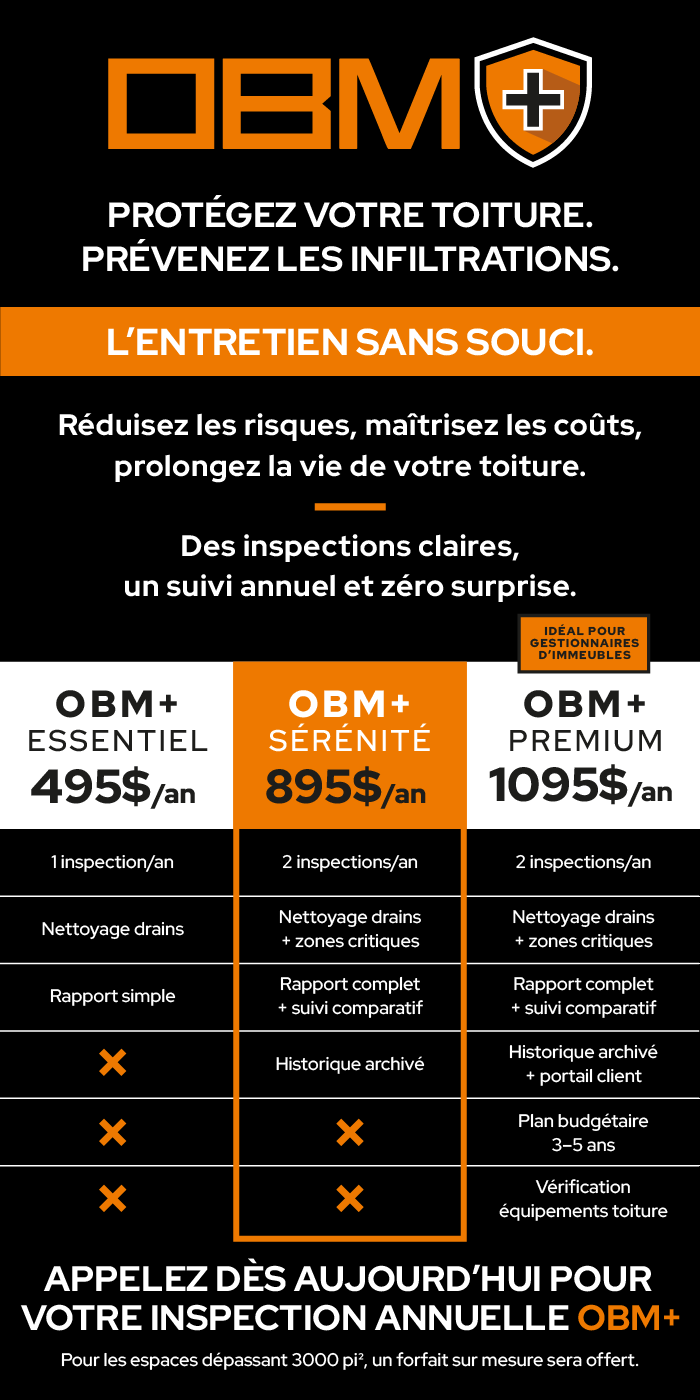
A well-maintained elastomeric flat roof can protect a building for several decades. Maintenance and inspection cover:
On commercial buildings and apartment buildings, it is also useful to keep an eye on the areas where technicians walk to service mechanical equipment, as the membrane is under more stress there. One inspection in the spring and another in the fall make it possible to correct small weaknesses before they cause water infiltration.
Toitures OBM is located at 1215 Tellier Street in Laval and carries out flat roof projects in Blainville and elsewhere on the North Shore, as well as in Laval and Montreal. Its team works on commercial, industrial and multi-unit buildings, as well as on residential flat roofs.
The company is Soprema PAQ+S certified, CAA-Québec Recommended and holds RBQ licence 5778-2823-01. It can be reached Monday to Friday, from 8 a.m. to 5 p.m. Financing is available through Financeit.
Not always. Dry insulation in good condition can sometimes be kept, whereas wet insulation must be replaced. An assessment of the roof makes it possible to determine this.
The first secures the components to the roof deck with fasteners, while the second relies on the adhesion of self-adhered membranes. The choice depends on the roof deck, the insulation and the job site.
Check with your municipality before work begins.
New construction, roof replacement or a simple inspection: Toitures OBM can assess your roof and explain the possible options. Call 514-449-5469 or request a free quote using the form.
OBM Roofing
Elastomeric membrane specialists for commercial, industrial and multi-unit buildings in Laval, Montreal and the North Shore.